Many of the ways companies operate were built around a degree of stability.
Demand followed reasonably familiar patterns. Supply arrangements gave production teams something dependable to work with. Companies set annual budgets, made plans and reviewed them at agreed intervals. When something went wrong, teams dealt with the disruption and worked towards getting things back to normal.
For that approach to work, conditions need to remain predictable enough for the plan to hold.
Today, businesses are dealing with several kinds of uncertainty at once. Climate change affects the physical conditions they operate in. Geopolitical tensions change trading relationships. Technology changes who they compete with and how. Customer preferences can shift while a product is still being developed.
The world is now far from stable. But many of the ways companies organise work and make decisions still assume that it will be.
When conditions change faster than a company can respond, the way it operates starts to hold it back.
That raises some practical questions. How does information move through the business? Who can make a decision? And how quickly can teams change what they are doing?
The assumptions behind the operating model
Every operating model carries assumptions about how the business works.
Annual planning assumes that leaders can make useful commitments for the year ahead. Functional structures assume that specialist teams can look after their responsibilities and coordinate when needed. Approval processes assume that the oversight is worth the time spent waiting for it.
There are good reasons for these arrangements. They make responsibilities clear and help a company operate consistently.
The problem starts when the conditions behind them change.
A monthly review may come too late for a developing supply disruption. A budget agreed months ago may leave a team unable to respond to a new opportunity. A decision involving several departments may spend more time travelling between them than being considered.
People find ways around this. They call urgent meetings, rely on personal relationships and manually pull together what they need. Eventually, the extra effort becomes part of how the business runs.
When getting ordinary work done repeatedly depends on exceptional effort, it is worth looking at the operating model.
1. From forecast driven to signal driven
Forecasts help companies decide where to put resources and how to prepare. But teams also need to recognise when the assumptions behind a forecast have stopped holding up.
A signal driven organisation pays attention to what is changing around it and connects those changes to the plans they could affect.
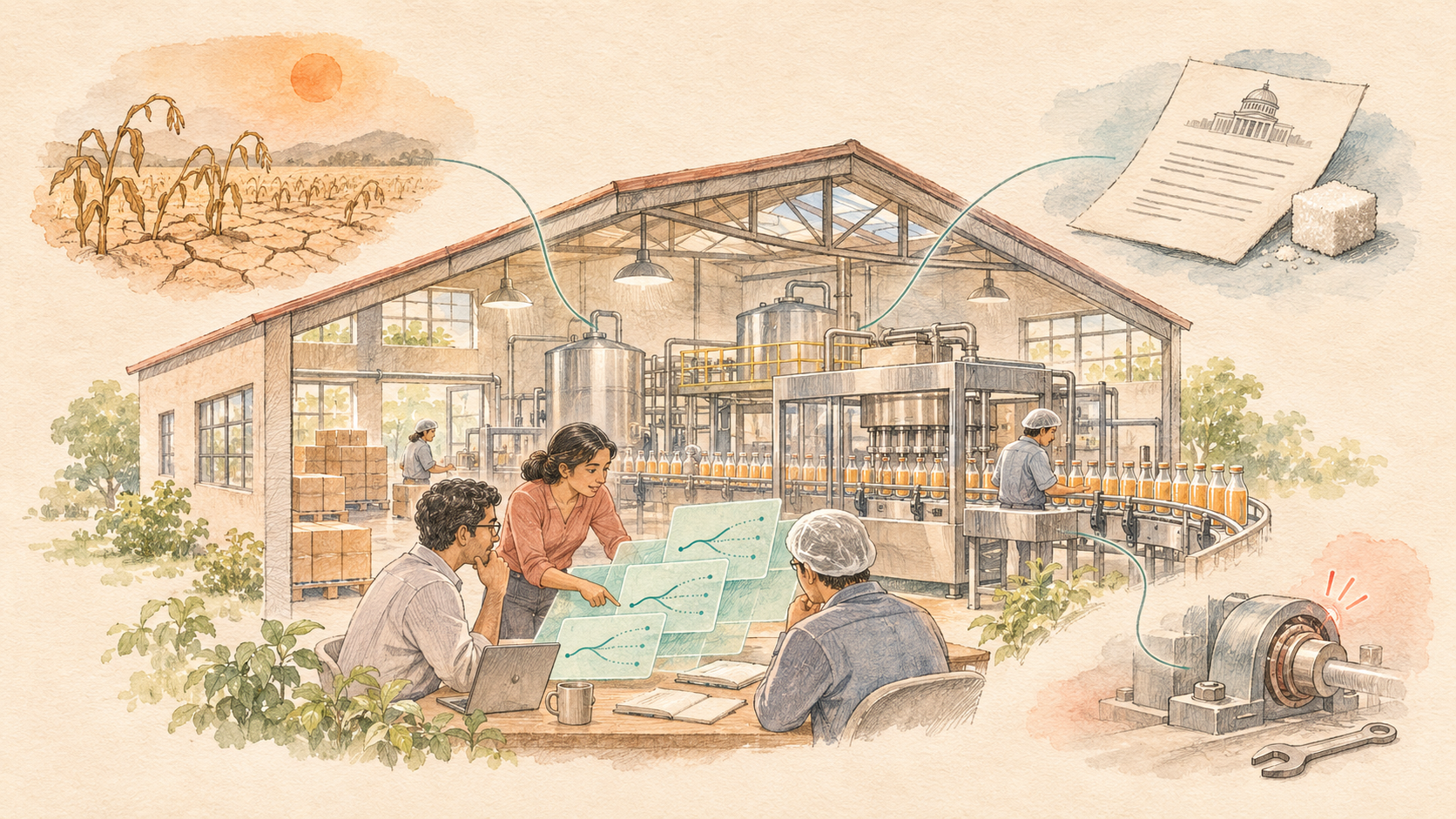
Consider a beverage company planning its next year. A proposed sugar tax could change the economics of some products. Signs of crop failure in a sourcing region could point to higher ingredient prices months before they appear in a supplier’s quotation.
Neither development needs to be certain before it deserves attention. The company can assess what a tax would mean for pricing and formulation, or how a poor harvest could affect costs and margins.
The difficult part is deciding which signals justify revisiting the plan and which simply need watching.
Historical data still has a role. The company also needs a way to bring in new evidence and question what it previously expected, while there is still time to respond.
2. From periodic decisions to continuous decisions
Companies organise many decisions around a calendar because scheduled reviews make it easier to get people together.
Changes in the business rarely arrive on that schedule.
A more responsive operating model allows teams to revisit a decision when circumstances warrant it. They need to know what should trigger a review, have access to the relevant information and have the authority to do something about it.
Some decisions need time. Some operational plans need to remain stable if they are going to work.
The question is what waiting will cost.
A change that threatens an important customer commitment may need attention today. A small deviation may simply need watching. A long-term investment may deserve several rounds of assessment.
Being responsive means knowing which decisions need attention, when they need it and who can make them.
3. From reactive operations to predictive operations
By the time a problem becomes obvious, a company may have few options left.
Think about a machine on a production line. If it breaks down during a run, the team has to stop production, arrange repairs and work out what happens to the orders affected.
AI can help identify signs of a developing fault before the machine fails. Changes in vibration, temperature or performance can indicate that something needs attention. That warning gives the team time to investigate and schedule maintenance during a planned shutdown or a quieter production window, reducing disruption to operations.
The same principle applies elsewhere. Recognising a potential capacity constraint early may leave time to move work elsewhere. Spotting an emerging supplier risk may allow procurement to qualify an alternative before a delivery is missed.
Predictive operations make this kind of anticipation part of everyday management. The value comes from connecting an early warning to something the business can do about it.
There are limits to what a company can predict. Some failures will happen without a clear warning, and a precise estimate can make people more confident than the evidence warrants.
That is why preparation matters too. Companies need alternatives, clear routes for escalating a problem and a shared understanding of which activities take priority during disruption.
Earlier recognition and preparation give teams more room to act, even when they cannot know exactly what will happen or when.
4. From human coordination to human and AI orchestration
A large part of making a business decision is doing the work that comes before it.
Someone has to gather the data, check what has changed, work through the dependencies and compare possible responses. By the time that work is finished, some of the information may already be out of date.
AI agents can take on much of this heavy lifting as digital co-workers. With access to the relevant systems and information, they can continuously assess changing conditions, flag emerging problems and run simulations to help teams understand their options.
Consider a potential capacity shortage. An agent could assess incoming orders against available production capacity, test different scheduling options and compare the effects on costs, delivery dates and customer commitments. As new information arrives, it could update the assessment.
People would then have a current set of options to work through, with the assumptions and consequences made visible.
That changes where human effort goes. Teams can spend more time questioning the assumptions, weighing the trade-offs and deciding what to do. A simulation may favour the cheapest response, while a leader recognises that protecting a customer relationship matters more.
Making this work requires clear responsibilities. Agents need boundaries for the information they can access and the actions they can take. People need to know when to intervene and who owns the final decision.
The operating model begins to change when this assessment becomes ongoing work shared between people and digital co-workers, rather than an exercise someone has to assemble whenever a problem arises.
Adaptability requires organisational choices
For F&B companies, the value of AI will depend on what happens after it identifies a risk or an opportunity.
An agent might flag a proposed sugar tax, anticipate an ingredient price increase or detect signs of a machine failure. The business still needs people who can decide whether to reformulate a product, secure alternative supply or change a production schedule.
That is where the operating model matters.
Teams can work from the same information and still pull in different directions. Procurement may be protecting ingredient costs, manufacturing may be protecting line efficiency and sales may be protecting customer commitments. AI can make those trade-offs visible. Leaders need to establish how they will be resolved.
A useful place to start is one recurring decision: how to respond when an ingredient becomes more expensive, when demand shifts or when equipment needs attention. Follow that decision across the business. Identify what AI agents could continuously assess, which scenarios they could test and who has the authority to act on the results.
Then judge the improvement through what changes in the business. Did the company protect a margin, avoid unplanned downtime or adjust a product before a regulatory change took effect?
For a Food & Beverage company, adaptability becomes real when an early warning leads to a better decision in time to matter. Building that connection between AI, people and action is the work of rewiring the business.
Loading comments…