When I started AI Palette in 2018, the consumer-insights toolkit inside most consumer goods companies was fairly predictable.
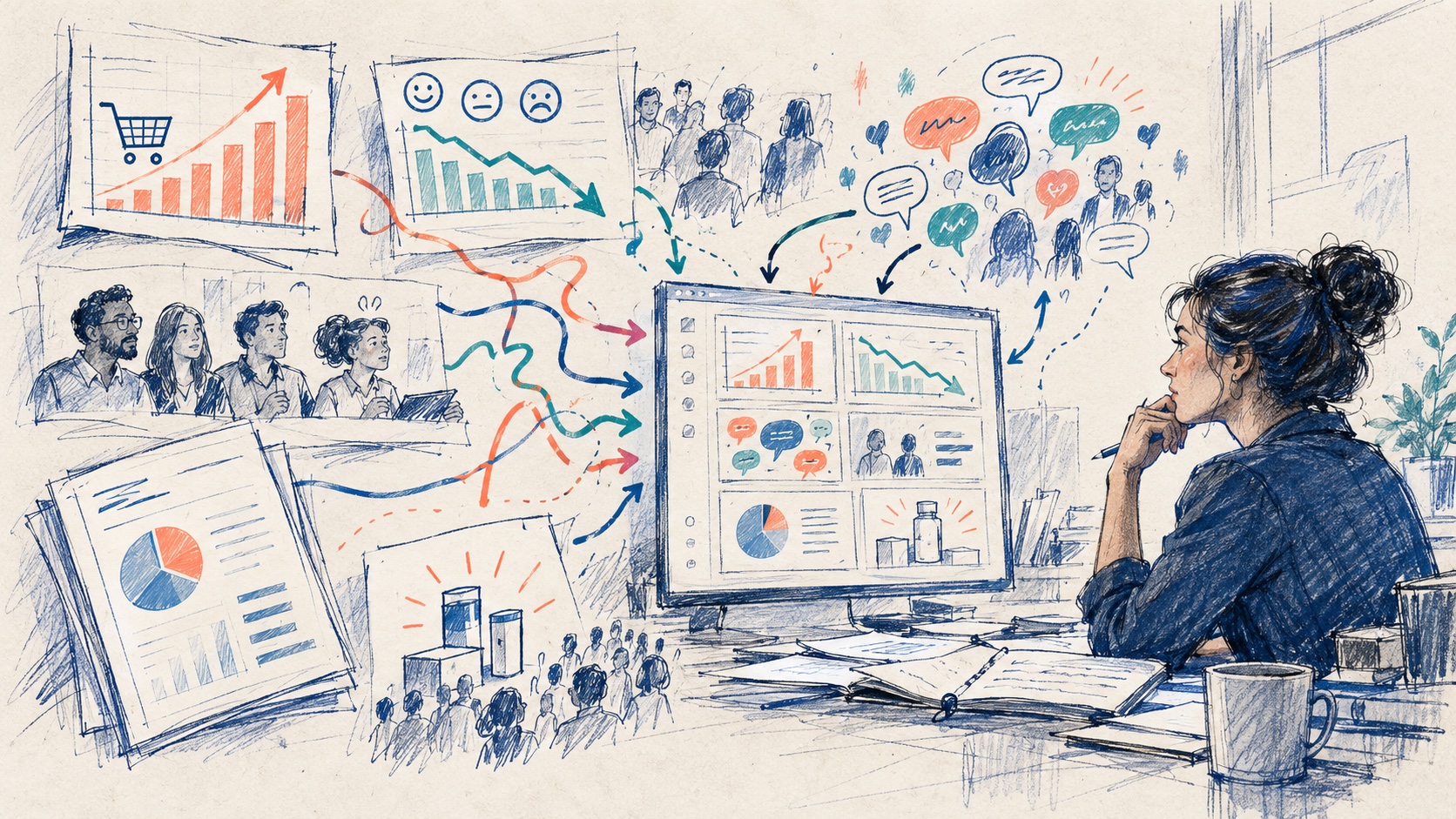
Companies bought syndicated research, subscribed to consumer panels, commissioned primary research and, in more advanced organisations, used social-listening platforms. Each source answered a different type of question, and expert analysts brought the pieces together.
AI Palette added a new source of intelligence. It helped companies identify emerging trends, understand changing consumer conversations and discover product opportunities from large volumes of unstructured data.
But our output rarely existed in isolation.
A customer might combine an insight from AI Palette with primary research they had commissioned, market-sizing data from Euromonitor or GlobalData, and new-product-launch information from Innova or Mintel. An experienced analyst would then interpret these sources and build a recommendation.
The analysis was valuable, but the process was still manual. Answering a seemingly simple business question often meant searching across several platforms, downloading reports, comparing taxonomies and stitching together a coherent story. Depending on the question and the analyst’s workload, it could take days or even weeks.
Eight years later, the toolkit has expanded significantly.
Companies now have trend-prediction platforms, synthetic personas, AI-moderated research, automated concept-generation tools and AI that can produce reports and presentations. Almost every part of the insights workflow has acquired an AI tool.
Yet the fundamental problem has not disappeared. In some ways, it has become worse.
From data scarcity to data abundance
Consumer information was once scarcer, slower and more expensive to obtain. Today, the challenge is increasingly one of fragmentation, interpretation and activation.
There is external data that companies buy: sales data, consumer panels, social conversations, search behaviour, market reports, product launches and primary research. There is also internal knowledge generated through previous studies, innovation projects, customer interactions and commercial decisions.
Each source has its own structure, definitions and taxonomy. A “health drink” in one platform may not mean exactly the same thing in another. Categories, occasions, claims and regions are often defined differently.
As a result, companies may possess most of the information required to answer a question but still struggle to assemble it quickly.
The next breakthrough in consumer insights will therefore not come from adding another source of data. It will come from connecting the sources companies already have.
Companies can now build around how they actually think
Until recently, creating a company-specific consumer-intelligence system would have been expensive, slow and difficult to maintain. Most companies therefore adapted their processes to the software they bought.
That equation is changing.
AI-assisted software development has made it much easier to build new applications and workflows. By 2030, companies will not have to rely entirely on generic interfaces created by research and software providers. They will be able to build, configure or commission intelligence systems around their own needs.
A snacks company, for example, may define categories, occasions and regions differently from another snack company. Two businesses operating in the same category may still have different brand positioning, strategic priorities and ways of evaluating opportunities.
Their intelligence systems should reflect those differences.
A company-specific system could understand the organisation’s category definitions, brand architecture, positioning, markets, business strategy and previous decisions. The same underlying market data could then be interpreted differently depending on the company asking the question.
This matters because one of the recurring problems with insights technology has been low usage. Companies subscribe to several platforms, but only a relatively small group of expert users knows how to navigate them properly. Other employees depend on those experts to retrieve and interpret the information.
A system tailored to the company’s language and embedded in its everyday workflows should be used much more widely. Instead of asking employees to learn six different platforms, the company could give them one place to ask questions and make decisions.
The consumer-intelligence layer
By 2030, I expect leading consumer goods companies to have a shared consumer-intelligence layer sitting across their research and commercial data.
A user will be able to ask a business question in ordinary language. The system will understand the question, break it into smaller tasks and coordinate specialised agents working across social, search, sales, panel, product-launch and primary-research data.
The output will not simply be a chart or summary. It will provide a recommendation, show the evidence supporting it and highlight where the available data is incomplete or contradictory.
For example, if a company is considering launching a high-protein snack in Thailand, the system could examine the size and growth of the category, emerging consumer needs, relevant social conversations, competing products, successful claims and previous internal research. It could then recommend which opportunity spaces deserve further investigation.
The recommendation would also take the company’s own strategy into account. An opportunity that makes sense for a premium health brand may not make sense for a mass-market snack brand, even when both are looking at the same consumer trend.
This does not mean the system will always make the “right” decision. Business decisions rarely have one objectively correct answer. But it should help teams reach better-informed decisions faster, with a clear record of the evidence and assumptions behind them.
Over time, the system will learn which questions are repeatedly asked, which signals matter to particular teams and which decisions are approaching. Instead of waiting for someone to request a report, it may surface an emerging shift, a competitive threat or an unanswered question before it appears in a research brief.
One interface does not mean one version of the truth
Connecting data does not automatically make the resulting answer valid.
Sales data, social conversations, consumer panels and qualitative research represent different populations and answer different types of questions. A social signal may indicate that a topic is gaining attention, but it does not necessarily tell us how large the commercial opportunity is. A survey may measure stated preferences without explaining what people will do in a real purchasing situation.
The goal should not be to flatten every source into one convenient answer. A credible system must preserve the methodology, limitations and confidence behind each piece of evidence.
It should show where the data came from, when it was collected, which population it represents and how reliable the conclusion is. When sources disagree, the system should make that disagreement visible rather than manufacture false certainty.
The purpose of a shared intelligence layer is not to produce one unquestionable version of the truth. It is to help people understand the available evidence, the tensions within it and the judgement required to make a decision.
Research companies may become data providers
This shift could also change the role of syndicated research companies.
Today, these businesses typically provide both the underlying data and the interface through which customers access it. But if companies increasingly use their own intelligence layer as the main interface, the research provider’s user interface may become less important.
The value will move towards the quality, exclusivity, coverage and reliability of the underlying data.
Euromonitor, Mintel, Innova, Kantar and other providers may increasingly feed their information into a company’s internal intelligence system. Their data will remain valuable, but users may interact with it through a company-specific agent rather than logging into each provider’s platform separately.
The syndicated research companies will not disappear. But they may increasingly become data infrastructure: supplying trusted information to the intelligence systems that companies build for themselves.
The dominant interface for consumer insights may therefore belong to the consumer goods company, not to any individual research provider.
What happens to the insights professional?
If routine searching, synthesis and report creation become automated, the role of the insights professional will continue to evolve.
Many senior insights professionals already operate as strategic partners rather than research providers. But where teams are still measured mainly by the reports they produce and the research they deliver, their value will increasingly move towards shaping decisions.
Insights professionals will spend more time framing the right questions, challenging assumptions, evaluating conflicting evidence and helping commercial teams understand what a recommendation means. They will also be responsible for testing the quality of AI-generated conclusions and recognising when an answer appears convincing but rests on weak evidence.
The insights professional will increasingly become a decision architect.
Self-service access to information will not make the insights function less important. It will decentralise access to insights while increasing the need for the function to establish standards, maintain methodological integrity and guide interpretation.
This may also change where the insights function sits within the organisation. Instead of operating mainly as a central team responding to research requests, consumer intelligence will become embedded in the everyday workflows of marketing, innovation, sales and strategy.
What will not change
AI can identify patterns across millions of data points, but it does not automatically understand people.
Human empathy, cultural context, field observation and curiosity will remain essential. Someone still needs to notice what the available data is not capturing, understand why people behave differently from what they say and recognise when a local cultural shift is being misinterpreted by a global model.
Synthetic consumers may help teams generate hypotheses or explore possible reactions, but they should not become a convenient substitute for talking to real people.
Trust will matter just as much as speed. Companies will need to know which sources an agent used, how it resolved conflicting evidence and where human review is required. The final accountability for an important decision cannot simply be handed to an algorithm.
The real mandate for 2030
The consumer-insights function of 2030 will not be measured by the volume of research it produces or the number of platforms it adopts. It will be judged by the speed and quality of the decisions it enables.
Subscribing to more databases will no longer create an edge when competitors can access much of the same information. The new moat will be the ability to connect that evidence with context unique to the company.
The organisations that win will stop treating consumer knowledge as a collection of separate subscriptions. They will build a shared intelligence layer that understands how the business defines its categories, positions its brands and makes strategic choices.
The advantage will not come from having more data. It will come from making the company’s knowledge work together.
Loading comments…